


Editor of "Regional Newspaper" Mantsevich: Sometimes I want to be behind bars... For a day, well, an hour!
This interview with Alexander Mantsevich, editor-in-chief of "Regional Newspaper", is part of the collection "Voice of the Generation of Freedom", a living testimony of the creative and civic presence of those who have not lost their voice even in exile, writes BAJ. The authorities closed the newspaper and website, and Alexander Mantsevich spent two and a half years behind bars.

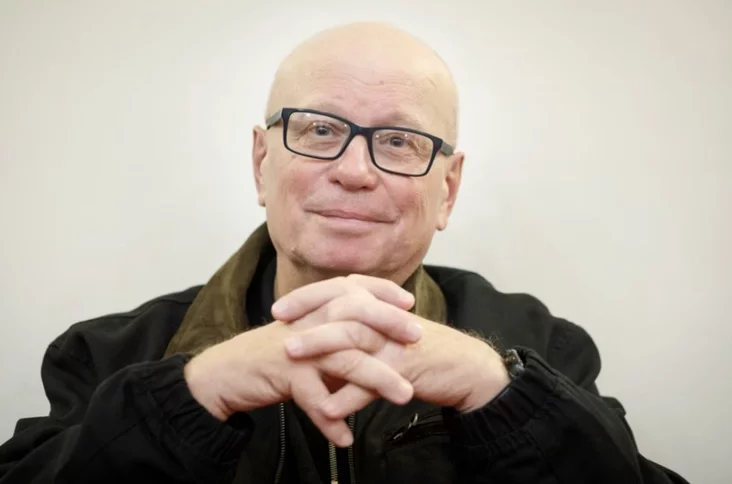
Alexander Mantsevich at the "Hope of Freedom" award ceremony. December 18, 2025. Photo: BAJ
The street of my childhood spoke "mova" (language), not "yazyk" (language). Now it has changed: the yard teaches exclusively Russian
— You said at the trial: "I still hear the voices of my ancestors." Do they echo from a distant childhood? What kind of Belarus did they talk about at home?
— Well, at least such a distant shot… My father is cycling me home from kindergarten (it's in Vileika, number three) and asks how the day went. I start babbling: we played war, we were Russians, and they... Dad interrupts:
— Son, we are not Russians!
— But the Russians won!
My father gently insists: Belarusians were not on the sidelines… That’s how it was: I hadn't even started school, quite small – but I heard who and what we are.
This moment is not accidentally remembered: a hook appeared in my child's mind, a thought began to swirl.
Self-awareness, of course, is more than simple understanding — it comes gradually. But I know for an absolute fact: I felt myself to be Belarusian not at twenty-five or forty years old — this elusive feeling appeared from an early age. And then it solidified, including through the Belarusian books among which I grew up.
Alexander Mantsevich was born in 1958. He graduated from the Minsk Radio Engineering Institute, later from the Faculty of Journalism of BSU. Founder and editor-in-chief of "Regional Newspaper". In 2023, he was sentenced to four years in prison for his professional activities, and in 2025, after his release, he was forcibly taken to Lithuania.
— Your grandfather Flor Mantsevich was connected with Belarusian schooling and national culture, your father was a respected journalist, a writer. I recall this family history because I want to ask: how did it align with the Belarus that textbooks, newspapers, and television presented to you? When did you notice a discrepancy between your family's biography and the official historical interpretation of the same events?
— Already in school — in the seventh, eighth, ninth grade, when I was able to think critically. The history of Belarus then was the past of the BSSR. And they began to study it not from ancient times, but squarely from 1917. The boundary of time… But I grew up among shelves with a lot of relevant literature, so I easily found inconsistencies.
And while still a student, I was strongly influenced by Korotkevich's book "The Land Under White Wings," which I bought in Mogilev. A popular textbook on the history of Belarus for youth… There I first found, for example, the surname of Kazimir Semenovich — one of the founders of reactive artillery, a military engineer who developed ideas for rocket technology in his scientific work. There were also other names that, with their unexpected specificity, pushed me towards local history and even deeper.
In 1975, I went to the Radio Engineering Institute. I finished school with Russian as the language of instruction, choosing a completely non-humanitarian profile.
However, when in an auditorium of a couple of hundred people, they asked who would write an essay in Belarusian, I raised my hand — I was one of three volunteers.
I even remember that topic based on Kuzma Chorny's work "The Third Generation" — "Zosya Tvarytskaya as a representative of the new Soviet era" (not "representatress" — that's the language of another time). In general, at that time I still operated with categories such as socialist realism, but it was a novel about Belarusians, a worthy Belarusian book.
What am I getting at? In life, there is not just black and white: in our time, Soviet and Belarusian lived side by side, subtly coexisting. I cannot say that one hindered the other, but the Belarusian in me still prevailed. And the Soviet gradually receded.
— You mentioned that you lived among books. What exactly was in your home library?
— The selection was primarily explained by the fate of my father, who graduated from the philological faculty in 1957. His friends and acquaintances from university eventually became iconic figures in Belarusian literature: Ivan Chigrinov, Vyacheslav Adamchik, Pavel Misko, Ryhor Baradulin, Gennady Buravkin… Dad was especially close friends with Pavel Andreevich. Each of his volumes had the author's autograph… That was magnetic.
But it wasn't just the printed word that influenced me. Every summer I spent in the Vileika village of Izha, visiting my grandmother Volka, my mother's mother. And I always spoke Belarusian there. How else?
— Was it different at home?
— It's like this: when I was born, my parents faced a cultural choice: what language would be the first for their son? And they decided: we'll teach Sasha in Russian — and he'll pick up Belarusian on the street. And that came true. Although they also spoke Belarusian at home. I had an equal attitude to both, as they coexisted completely peacefully in our family. But I will emphasize: on the street during my childhood, "mova" (Belarusian language) prevailed, not "yazyk" (Russian language).
But today, Belarusian-centric families must make a different choice — to teach their child in Belarusian. Because everything has changed: now the street is dominated by Russian.
There's a photo: in the foreground Stalin, Kalinin, and somewhere in the fifth row my grandfather, Flor Mantsevich… When he returned home, he cried: "They sold Belarus"…
— Your grandfather fought for the Belarusian idea in interwar Poland, and in 1939 he supported the unification of Western Belarus with the BSSR. How do you understand his choice today: did he vote for the Soviet system — or primarily for Belarus, which he wanted to see united?
— My grandfather and I never met: in 1941, when the Germans came, he was taken away as a Soviet non-party activist, a fighter for Belarus. And the man was gone. Shot, probably in Polotsk.
One thing I can say with certainty: he genuinely, consistently, and purposefully fought for the national school. According to my father, the Polish authorities at the time changed his place of residence eight times so that he wouldn't settle in one spot. Because as soon as he was transferred, say, from his native Nivniki to Malaya Kavaleushchyna, he would immediately start collecting signatures from the local population again for a school in his native language.
He himself graduated from a teacher's seminary in Polotsk even before World War I. I think the man had a keen sense of justice: people have the right to study from their own Belarusian textbooks.
Perhaps that's why in 1939, when the Red Army crossed the state border between Poland and the USSR on September 17, he perceived it (again, according to family legends) with great enthusiasm: Belarus is returning! You can't paint everything with one color: for him, it was precisely like that… And what else came at the same time, he, it seems today, never fully understood.
Grandfather participated in the People's Assembly in Bialystok, which decided on the reunification of Western Belarus with the BSSR. He was part of the group that traveled to the capital of the USSR. To this day, a leather folder with an image of the Kremlin and the inscription "Moscow" lies at home. There is a famous photograph: in the foreground are the Soviet leadership — Stalin, Kalinin, next to them members of the delegation, Pritytsky and others, and in the fifth or sixth row stands Flor Mantsevich…
My father's childhood memory preserved an episode: when grandfather returned from Moscow, he cried and said that Belarus had been sold. True or not, but such is the family legend. People are also raised on myths and legends.
I live with the feeling that something was completely wrong with our entry into the BSSR to this day. September 17 is a tragedy for Poles, but for us, it is an act of national reunification within common borders. We, Belarusians, did not decide Poland's fate then. Everything is very complex.
When my Polish friends visited me, I always showed them: in any Western Belarusian town or village, there is a September 17th Street. This was even before the propaganda frenzy of recent years. I told my esteemed guests: "We have one date, but different histories. I apologize that we view it differently. But that does not mean we must live in the past. We need to look to the future and build history together."
— Once your grandfather officially "stood up" for Belarus precisely in Bialystok. Today Bialystok appears again in your story — you visit here, meet with colleagues and acquaintances… What do you think about when you walk through places that remember the late Mr. Flor?
— When I was imprisoned for "discrediting the Republic of Belarus," I acutely felt the absurdity of the situation: our newspaper is Belarusian-language, Belarusian-centric, wrote about love for Belarus, and those who spit on the Belarusian language and history are bringing charges against me. And the fact that I had the examples of my grandfather and father before me helped me endure.
— Did your family history teach you to distinguish Belarus from the state that governs it at a certain moment?
— I have always separated these concepts. The state is primarily an apparatus. And the country is the people, it is much more. The more actively the people influence their fate, the more the state and the country coincide. In our case, such a coincidence is not happening now.
Moreover, Belarus for me exists beyond state borders. I'm not talking about any claims to Smolensk, Vilnius, or Bialystok, but about the fact that people and culture have no borders. The influence of the national is much wider. When Danchyk came in the 1980s and sang Belarusian songs — that is a manifestation of the same Belarusianness I am talking about.
Belarus for me is a much broader concept than just a state.
Almost everyone lived by the rule that besides salary, you absolutely had to take something out of the factory, because there wasn't enough money
— So that the reader doesn't think Ales Mantsevich understood everything from childhood: what seemed completely normal or even good about the Soviet way of life when you were a student, an inexperienced engineer?
— I remember myself as an exemplary Komsomol member: participant in construction brigades, studied well, read Komsomol press, believed in promises — for example, that in twenty years everyone would be provided with housing, including my young family. I had hopes for a bright future that Soviet society would create. All of that was a continuation of the school feeling: how happy I was to be born in the Soviet Union, and how many poor peers there were in that decaying America!
My worldview began to fade when I started working at "Zenit" in Vileika — the Belarusian Optical-Mechanical Association. Since there was no engineer position, I was sent as a shift foreman to the paint shop, where mostly women painters worked. The factory was large, city-forming: five thousand people.
And the senior foreman, the good-natured Georgy Petrovich Garid, who was only a year or two older, told me, the romantic, on the very first day: "Here you will learn to read Soviet newspapers between the lines."
And indeed, reality corrected my perceptions. I realized: what is poured into our ears and what happens in the real life of workers' collectives are often completely different things.
I saw how some believed that besides their salary, they absolutely had to take something out of the factory, because there wasn't enough money. At first, I thought — rare cases, anything can happen. But later it turned out: petty theft was commonplace here, hardly anyone condemned stealing from the factory.
An episode comes to mind. I meticulously watched and worried that the quality control department would check the quality and that defects would not get into assembly. If there was a mess — let QC stop it, we'll rework it.
And so, on the last day of the month, Deputy Director Vlasov gathers a planning meeting: several hundred bodies are missing from assembly, everything lying around must be immediately handed over.
I say:
— There are some on my shift, but only defective ones.
— What's the difference — hand them over!
I fundamentally refused to sign documents for defective parts. The boss flew into a rage:
— Get out!
— Fine, just give me permission to leave.
The enterprise was a restricted facility; they wouldn't let you out without a pass. So I left.
The next day I learned that another foreman had signed everything, the plan was closed, and bonuses were paid out.
Then I understood: the management needed to close the monthly plan at any cost to get bonuses based on its results. And what would happen tomorrow — it didn't matter.
Such was an important school for understanding reality.
— And how about the school of collectivism? Did you see examples of a different kind, when a brigade lived amicably, supported each other? Did you feel strength and energy in that collectivism, which books, songs, films, and speeches talked about?
— This inevitably arises in a brigade or workshop when common production goals are set or leisure time is organized — Chemist's Day, tourist rallies… A team of thirty people can often do more than each individually, leading to satisfaction with the collective result and pride in it. Which Soviet propaganda very cleverly exploited.
The feeling of collectivism is bright. But its results were not used by us, but by a narrow apparatchik layer. Many bosses had no moral brakes at all…
For me, the 1990s were a time of feeling freedom and that we ourselves choose our future
— In the already new Belarus, you created the editorial office of an independent newspaper. What was harder then: learning to write freely — or managing your business efficiently?
— Both were not easy. I went into journalism back in Soviet times — to the Maladzyechna district newspaper. This was hereditary, from my journalist father. I liked it: people come, tell their stories, and then what's written down appears in the newspaper. I was eager: why not try it myself? And while still working at the factory, in 1984, I enrolled in the journalism faculty by correspondence, already having a family and a daughter.
In the late 1980s, changes began. One day, at a chance meeting, my classmate Dzima Filimonau asked:
— Haven't you thought about your own newspaper?
I was surprised:
— With what money?
— Nearby, in Poland, there are examples of successful local publications.
By that time, we had already changed the loud name "Light of Communism" to the specific "Maladzyechna Newspaper". And there I eventually became the head of the advertising department.
Entrepreneurs came to us, many often asked to place their advertisements also in the neighboring Vileika, Miadzel, Valozhyn, Ashmiany, Smarhon, Astravets districts: all of them are nearby, and Maladzyechna is the largest. That's why I registered myself as an entrepreneur and began placing advertisements where required. Gradually, I came to the idea: why not create a newspaper that would cover all these districts at once?
When I started discussing the business idea with the guys, we realized: an editorial office cannot just print ads; we need to attract readers with interesting journalistic materials. We found support from local businessmen. They helped publish the first ten issues, after which the publication began to generate revenue through advertising.

We were free, independently choosing themes and issues without regard to city committees, district committees, and district or city executive committees. Adhering to legal and ethical norms.
— What is the distance between such freedom and economic independence?
— If you're not constrained by resources, you can think and write freely. Later, we developed the concept of a mission: it's about responsibility to the reader who believed that the editorial office produces truthful information. In 1995, we were truly independent and wrote without any manipulation of facts. What we saw — that's what we showed.
— The 1990s taught that much that is important in life depends on ordinary people. Was there a prevailing mood of "just get through the day and survive the night"?
— For me, it was a time of feeling freedom and that we ourselves choose our future. At the factory until 1987, I received a maximum of up to two hundred rubles with all supplements and could not influence my future salary level. But when I left, I understood what economic freedom was. I registered as an entrepreneur, engaging in the basics of publishing. My responsibility for my family also increased.
But alongside, I saw countless tragedies. Hundreds of engineers from our factory lost their jobs because their specialty became unnecessary, and they went to Poland or Russia — becoming ordinary shuttle traders. Some gradually grew into successful entrepreneurs, some even rose to serious business. At the same time, many broke down, gave up, ruined their families, drank themselves to death, perished.
Any reforms go through a crisis — Poland and Lithuania experienced a similar one. We got a chance to use economic freedom, and our neighbors realized it.
— Aren't there two opposing processes here? Freedom pulled people forward, but it destroyed the sense of unity. Or did it somehow combine in a strange way?
— As for our "Regional Newspaper" — it was precisely aimed at uniting local efforts in seven districts. Common territory, history, and connections between people brought us together.
The publication united readers from four districts of Minsk Region (Valozhyn, Maladzyechna, Vileika, Miadzel) and three of Grodno Region (Smarhon, Ashmiany, Astravets). That appendage is geographically cut off from Hrodna by two hundred and fifty kilometers, while Maladzyechna, the former regional center, is nearby. Hrodna residents always traveled here for the market and shops. So we decided to capitalize on historical, geographical unity.
I remember when we just started organizing subscriptions, an old man from Astravets exclaimed:
— So, Maladzyechna region is coming back!
For people, the feeling of regional unity of destiny was very important.
Through the newspaper, the local community was united. We printed many historical and local history materials. And time and again we were convinced: it's impossible to divide the figures of worthy people between districts: Adam Hurynovich, for example, was born on the border of today's Miadzel and Vileika districts — his biography connects us.
Thanks to the weekly, local historians from Smarhon region, Vileika region, and Miadzel region met. For example, Anatol Rohach from Vileika made discoveries in biographies, and his articles were read in neighboring districts. Teachers used publications in their lessons.
Even private "buy-sell" ads oddly brought people closer, effectively establishing economic relations between them.
It never even occurred to me to publish something in Russian. It's natural: I'm in Belarus, we need a newspaper in our own language
— You meticulously observed a dozen districts for a quarter of a century. Did the Western Belarusian person truly differ from the Eastern one in their attitude towards property, language, work? Or is it just a myth?
— It's both a myth and a truth at the same time. Residents of different villages and different regions differ. "Westerners" and "Easterners" have different historical experiences.
For example, World War II came to our region in September 1939. My fellow countrymen had already fought near Piotrków Trybunalski in Poland then and died. We published articles about this, revealing the resting places of their relatives to people. In Eastern Belarus, there is no such history, but they remember 1937 there, which Grodno Region, Brest Region, and Western Polesie did not experience to such an extent.
Historical experience is different, but those who consider themselves Belarusians are united by belonging to one people, a common language, and deep historical roots.

— "Westerners" had a living memory of living differently before the Soviets. Did this sense of ownership work in the nineties?
— To say that one region is worse or better is unacceptable. My wife is from Eastern Belarus, from Homel region, I am from Western. She knows history through her parents, I through mine. And our children are already heirs to a common history.
As for the entrepreneurial spirit, it's true — perhaps it persisted more strongly here. I remember my grandmother in Izha taking me to the collective farm stable and proudly, fondly showing me a horse:
— This one is ours.
It whinnies, stretches its muzzle to a palm with bread… Collective farms came here in the 1950s; people there long remembered who owned the lands, hayfields, and animals. The feeling of working on an individual farm also persisted.
A colleague from Eastern Belarus married a local girl from Smarhon district and boasted: his mother-in-law sold the best milk in Smarhon! And why? Because under the Poles there were dairy schools that taught sanitary standards — for example, cooling raw milk immediately in a well, and this immediately improved its quality. Such trifles were not forgotten; in certain circumstances, they sometimes helped a lot.
Another example: we went with an employee of the Vileika museum to a woman whose father was repressed after 1939. I asked how they lived and to which market they took pigs to sell? She looked surprised and replied with a smile of misunderstanding:
— Where else? To Vilnius! What other market?
Here it is: the feeling of the region's history, pride in it.
It seems to me that in our part of Belarus, both such practical skills and the very feeling that one could run a farm oneself lasted longer. In the east, earlier collectivization largely erased this memory.
— Even in journalism, Kolas's metaphorical "acquire land, buy one's own corner" resonated more strongly: independent regional press in the west of the country developed more dynamically. And in the east, it was liquidated much earlier…
— In the early and mid-1990s, when the press could be freely registered, we indeed surpassed our colleagues closer to the Russian border. If you draw an imaginary line based on the density of publications, circulation, and readers, it would probably divide Belarus into eastern and western parts.
— You spoke about the mission of "Regional Newspaper" — to help the reader feel part of a community. What needs to happen in a person's mind for them to stop being just a resident of Vileika or Maladzyechna and start feeling responsibility for the place where they live?
— Responsibility consists of elementary, fundamental things. For example, when you go into nature — do you leave trash behind or clean it up?
All of this is born from an understanding of who you will be remembered as by your children and grandchildren. Likewise, we, publishers, are remembered by our readers. Will they remember us or not? We produce a sum of knowledge. Even if a person doesn't always realize where that knowledge came from, a part of it was given by the newspaper.
That's where the feeling of unity, of one whole, comes from — a long path traveled together. From this emerged a sense of local, regional community. This means we haven't lived in vain, if we leave behind something so important.
— You started a Belarusian-language newspaper, but not only for already convinced Belarusians. Is it difficult to talk to readers in a way that doesn't demand they become "correct," but instead includes them in the Belarusian community without pressure, through interest?
— We shouldn't force anyone into anything. A person makes their own choice. Perhaps at first, it's not very conscious: maybe they just liked an easy but interestingly written criminal or sports publication. Afterwards, they'll get to know the newspaper better, delve into something else, find something deeper they like, and slowly, imperceptibly, become our fan, and then realize: "And I didn't even notice how I'm reading that newspaper in Belarusian!"
It never even occurred to me to publish something in Russian. It's natural: I'm in Belarus, and Belarusians need a newspaper in their own language. I practically never noticed a negative attitude towards our "Regionalnaya" for such editorial policy. I heard bad things occasionally, but these were very marginal statements.
It's important that besides the language, there is also quality content. But, I repeat, for a Belarusian, language is a value.
And our reader was, let's say, more "quality" than the reader of Russian-language publications — no offense to them. They are held by a feeling of kinship, of one family.
In 2004, during the electoral campaign, the Ministry of Information suspended the publication of several newspapers, including ours, for three months. And immediately — this is unprecedented! — complaints flew to the Ministry of Information, to the Presidential Administration, through various instances. Parliamentary candidates, in their public speeches on television and radio, spoke about this incident, specifically highlighting "Regionalnaya."
Incredible: half a month later, the Minister of Information revoked his order for "Regionalnaya."
From above, I was quietly whispered to:
— We have sacks of letters here in your support.
And later people came to the editorial office and admitted:
— If the newspaper wasn't in Belarusian, we wouldn't have done anything.
That's what that "quality" of the reader is all about.
— He changed before your eyes: from quiet kitchen grumbling to calls to the editorial office with demands on specific officials, then to picketing in defense of a street. And finally — advocating for his newspaper…
— Yes, these were manifestations of community, of something new.
Of course, the newspaper built trust. In our state, there is no self-government, as in other countries, where locals decide: here a bench should be placed, and there a bus stop. In our case, this is replaced by decisions of the appointed vertical.
And part of the function that local self-government performs in a normal system was probably taken on by the newspaper.
If we had the status of a district or city newspaper, we would be closer to people's everyday problems — pointing out every pothole in the asphalt or broken tree to the authorities. But we chose a much larger territory. Therefore, we more often performed this function by responding to complaints, appeals to the editorial office, and readers' desire to influence something. People came to us daily as if for confession to a priest.
The editorial office grew together with its audience.
— 2020 was the peak of popular freedom. Did you catch the feeling that you were finally seeing the society you had been helping to cultivate for so many years?
— Perhaps so. I just didn't see: what next?
In the midst of events, I gave an interview and said:
— We have stopped being afraid.
It turned out: it's important, but not enough on its own.
Perhaps our contribution is also in this: people began to look at the world more openly, grew in their civic activity, and came to the realization that a person is born free.
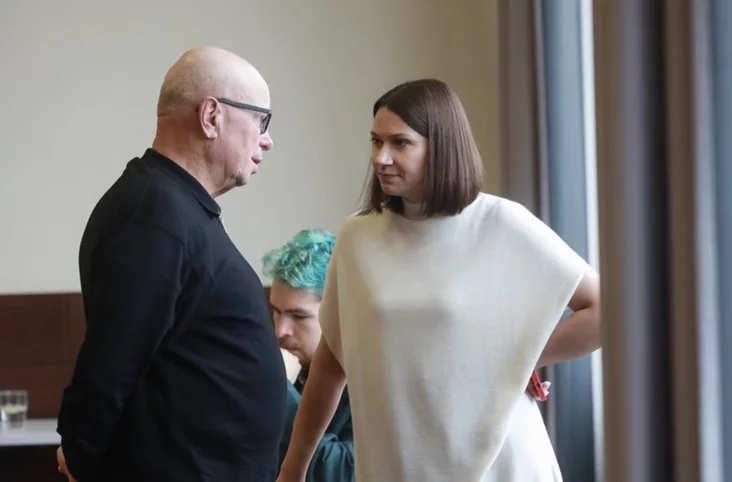
— "Regionalnaya" nurtured a whole galaxy of excellent journalists, organizers of new media, who literally spilled out of the newsroom into Minsk, where they took top positions. Tell us about your staff.
— There are examples to boast about, and there are others — when people went not into journalism, but into propaganda. Although the former are incomparably more numerous. But I don't want to personalize, so as not to offend any of my worthy protégés — highly professional individuals…
I'll say something strange, not understandable to everyone: sometimes I want to be behind bars… For a day, well, an hour! For my friends…
— Twenty-five years of newspaper optics, and then — a cell, a penal colony… Before you now is a completely different cross-section of the country. What did you learn there about Belarusians that you didn't notice as a journalist?
— I didn't think such conditions existed. And that thousands of people suffer so much in them. For the first time, I truly felt the harshness of unfreedom: you wake up in the morning and cannot plan your day, because you are entirely at the disposal of the internal rules. Every step and movement is under strict control. Both body and soul.
Though it was easier for me than for many other political prisoners and just inmates: I am a pensioner, they didn't drag me to forced labor.
And I learned a lot of different things about people… There they most often reveal themselves as they truly are; almost no one can hide their inner falsity. You quickly understand whether it's worth maintaining contact with a person, whether you feel comfortable or uncomfortable with them.
I'll say something blasphemous, strange, not understandable to everyone: sometimes I want to look at my acquaintances who remained behind bars… Even if just for a day! This is not masochism, but simply memory, a duty to good friends — an incessant pull to know what happened to them over the past year…
— But not with everyone?
— In the colony, there were thirteen bunk beds in the section — for twenty-six people. I once counted: seven of them were imprisoned for murder.
Criminals? To socialize with them? How?
In general, it's important to understand: the penitentiary system is a terrible state within a state. People also die there; five people passed away during my time… You can't even influence your own health.
The doctor at the first examination, upon hearing my complaints, said: "How long are you in for? Four years? Well, you'll get out and get better."
But even in this system, different people work. There are those who deliberately went to mock, and there are those who understand everything and even treat you with respect. They are a minority, but they exist.
— What were the relations between political prisoners and those incarcerated for criminal offenses?
— I didn't encounter any bans on communication. I heard about such things, but not in our colony in the Ivatsevichy swamps. Between normal people — normal relations. People could be imprisoned for various reasons. The concept of "us" exists there.
Among political prisoners, of course, there is greater unity, solidarity, and empathy.
When I was thrown into the squad after quarantine, Dzmitry Semchanka, whom people know from television screens, was the first to approach me. Although we weren't acquainted. He asked about my case, my needs, offered support in any situation.
Political prisoners try to help each other: give a mug, a kettle. But even real criminals often sincerely helped and gave advice.
— Did it happen in the colony to talk about Belarus, history, language? In native words or Russian?
— Mostly in Belarusian: I wrote statements, and made the cell duty report… There were never any repressive consequences, except for one case.
The deputy head of the prison in Zhodzina, Alyashkevich, came in. As usual, I reported in my own language, and he demanded I speak "in Russian".
I asked:
— Is that your request — or an order?
— An order.
If it were the first — that's one thing, but if it were the second, then:
— Your order is unlawful.
He looked at me, at the eleven people listening intently, and with a threat:
— Now the whole cell will answer for this.
What to do in such a case? I had to switch to Russian for the sake of the guys at that moment.
The only incident in three years.

And when registered letters arrived at the colony, I had to go to the censor with them. He looked at the Belarusian text:
— Hmm… But never mind, never mind, we'll switch now.
I told him:
— You just need to flip a switch.
Afterwards, we greeted each other with a smile — that's how the code of Belarusianness contributed to good relations.
— After your release, you mentioned Roma people in the colony. What drew your attention to them?
— They call themselves Roma and are not offended by it. I raised the topic because there are many of them there. It seemed to me that one of the big problems is education.
Many of those I met read and wrote very poorly or couldn't at all. And this passes from generation to generation: "My father didn't study, and neither will I."
Although I befriended one — he even wrote poems in Russian and Belarusian for his girlfriend. He let me read them.
They feel belonging to both Belarus and their people. Their surnames are Belarusian, and their faith often corresponds to the environment in which they live: among Orthodox — Orthodox, among Catholics — Catholics.
— What did prison remind you of about the Soviet type of person: obedience, hierarchy, fear of authority?
— There were prisoners who consciously collaborated with the administration, engaged in denunciations to get early release or amnesty, adopted inmate concepts…
But most of all, I don't understand when people don't consider themselves free inside. A sergeant or colonel said — and a person acts, not listening to their inner "self".
In the colony, to the words "I think," the citizen-chief replies: "Don't think, someone has already thought for you."
It's simpler to live that way, because you don't have to be responsible for decisions. But it is humanly dignified to think for yourself and see your own future.
— As they say, it's easy to judge others… And what from the Soviet era remained personally in you? What are you proud of? What, on the contrary, are you eradicating?
— From Soviet times, my faith in myself, not in God, lives and strengthens within me. Forgive me, my friends, I respect your feelings, but: I believe in myself.
And what I'm eradicating… That same feeling of collectivism: sometimes I want to become a grey cog, to hide behind the collective. But you realize that won't work for long — you have to make decisions yourself and be accountable to yourself.
— On what should the new Belarusian "we" be based?
— I would put solidarity first. 2020 is our shared history, which unites us.
And, of course, our own language. Many Belarusians are deaf to it, but we must promote it to take an honored place — through schools, education, books, new media.
And to the Belarusian elite, I have an unambiguous demand: not to despise the native word, to use it wherever possible.
— If you compare the Belarusian of your youth and the Belarusian of 2020, what has changed the most?
— In our student days, we didn't separate ourselves from the Soviet. We didn't think we would live to see a sovereign Belarus, but it happened!
Today's Belarusian is aware of being a citizen of Belarus and a person belonging to the Belarusian people, wherever they may live. In our time, such a thing did not exist.
— You said at the trial that a "Regional Newspaper" street would one day appear. What needs to happen for that to become a reality?
— I believe that such a street will appear, for example, in the small village of Verkhniya Tului in the Maladzyechna region.
We inscribed a line in the history of Belarus. Together with readers and authors, we discovered the oldest elm in Belarus there — and this is also a line in the centuries-old history of the country.
Even if there are only five houses in the old settlement, there must be a "Regional Newspaper" street! This will begin to mean that Belarus is winning and that it is one land.
-
Ukrainian Woman Outraged After Russian Stylist Cuts Her Hair in Warsaw Salon. Turns out the Stylist is Belarusian
-
Lukashenka: It's time to return to the practice when Belarus was responsible for Kaliningrad, St. Petersburg, Moscow Oblast, partly Moscow
-
"Europeans are not obliged to follow Americans at all." The representative of the Polish president commented on the appeal of a group of Belarusian political prisoners to the leaders of European countries
Now reading


Adviser to the President of Poland commented on the appeal of Kolesnikova and Zolotova: Lukashenka releases several dozen prisoners, and detains new ones the next day

Adviser to the President of Poland commented on the appeal of Kolesnikova and Zolotova: Lukashenka releases several dozen prisoners, and detains new ones the next day


Palchys on the letter from Kolesnikova and Zolotava: "For all that is good, against all that is bad", but in reality, it will leave 9 million in a local DPRK


Comments