


Lecture on Navahrudak nobility in the 18th century to be held in Warsaw
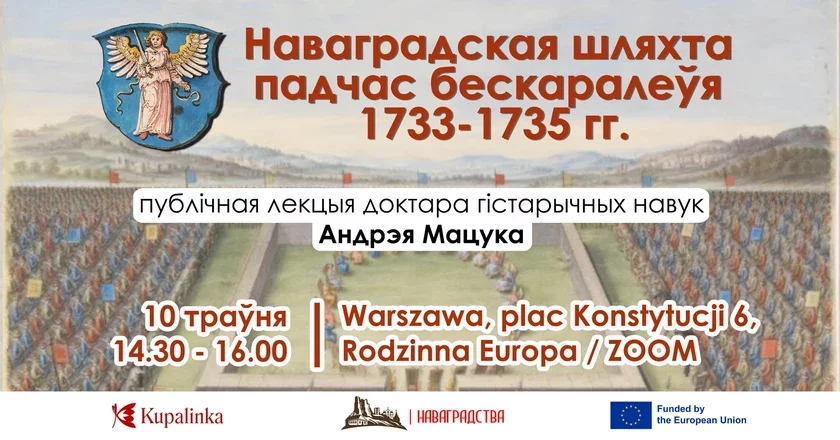
On Sunday, May 10, the "Navahrudstva" community invites to an open lecture by Doctor of Historical Sciences Andrey Matsuk titled "Navahrudak Nobility during the Interregnum of 1733-1735".
The interregnum of 1733-1735 ended with the victory of August III over the popular Stanisław Leszczyński, thanks to Saxon and Russian troops.
The first steps for August III's victory were laid on September 14, 1733, when the nobility, disagreeing with the election of Stanisław Leszczyński as king, protested in the Warsaw suburb of Praga.
The Navahrudak nobility constituted about 40 percent of the opposition to Leszczyński and on October 5, 1733, formed the basis of the electors who voted for the election of the Saxon Elector Friedrich August as king under the name August III.
The merits of the Navahrudak nobility were also noted in the act of the General Confederation of August III's supporters, which included the act of the Navahrudak Confederation.
And this is understandable, as it is the only case in the history of the Polish-Lithuanian Commonwealth when the position of the nobility of one voivodeship had exceptional significance for royal elections.
Admission is free. There will also be an online broadcast via Zoom — you need to register for it at the link.
The lecture will take place on May 10 at 2:30 PM local time: venue: Rodzinna Europa, pl. Konstytucji, 6, Warsaw.


Comments
А значит письмо Витаута Сигизмунду это дипломатический маневр,что бы обосновать претензии на Жамойць.
Второе на что Хочу обратить внимания в мирном договоре между Галицко-Волынским княжеством и 4 балтскими княжествами (Литвы,Жамойци,Деволтувы,Нальшаны),80% той самой Литвы в составе Беларуси.
Третие,Речь Паспалитая было конфедеративным государством (а значит ВКЛ было независимым княжеством до 1795 года),потому,что существовало право либриум вето и все решения принимались консенсусом как в Европейском Союзе(или евразийском экономическом союзе).
Старобелорусский письменный язык исполнял роль государственного до 1696 года,а потом польский,но не литовско-аукшайтский.
Например проведение каждого третьего сойма в Гродно было юридический закреплено в соймовой конституции 1673 года,а проведения соймов в Варшаве и Кракове это была традиция,которая не регулировалась никаким юридическим актом и нарушалась. Например коронационный сойм 1648 года проходил в Варшаве,а звыйчайны сойм 1594 года проходил в Кракове.То есть у Гродно был высший из возможных юридических статусов.