


A volunteer recounted his service with Lazouski and his last combat mission in Bakhmut
Four years ago, a Belarusian, now known as "Nyoman," went to fight for Ukraine's freedom. He told "Nasha Niva" about his journey in the war, his service with Miroslav Lazouski, and May 2023, when "Nyoman" was wounded, and Lazouski remained in Bakhmut forever.
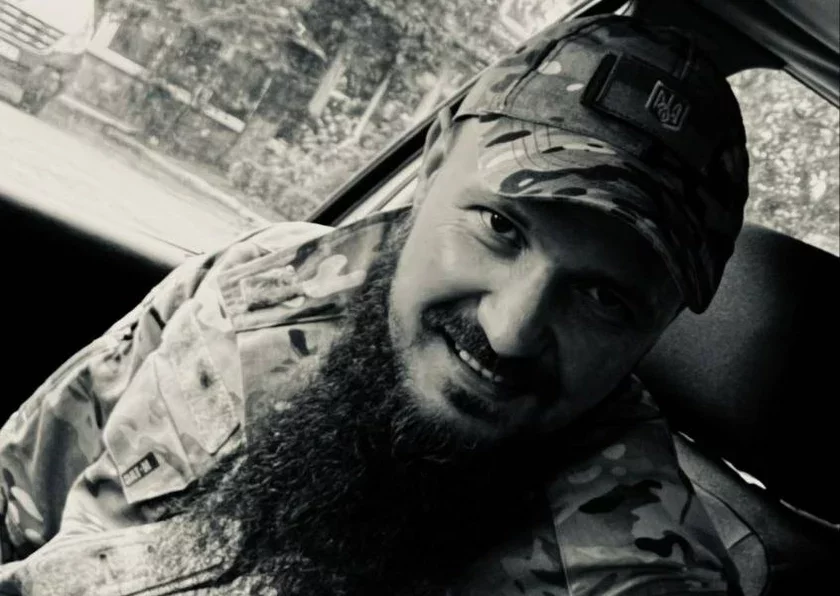
"Nyoman"
"Nyoman" is 39 years old. He grew up in the Hrodna region, near the bank of the Neman river. That's why he chose this call sign, to remind him of his favorite river:
"The Neman there is very beautiful and steep at the same time. I lived near it, literally three to five minutes [walk]. Of course, I went there in my childhood, fished, played various children's water games. I studied in Hrodna. So, when I was choosing a call sign, it just came to mind."
The man says that his interest in Belarusian identity began in his school years:
"You read one thing in textbooks, and hear something slightly different [from other sources]. You compare and try to find the truth. For example, the Kalińowski Uprising, the times of the BNR, the Slutsk Uprising were poorly described in textbooks. You start to be interested [in history], and it turns out - damn, Belarusians are still different from those same Russians."
As he grew older, his curiosity about Belarusianness developed into concrete actions. "Nyoman" says that from the age of 18, he ran for local councils of deputies, and later for the House of Representatives. In addition, the young man collaborated with various parties.
Of course, he had no hopes for those elections:
"I knew beforehand that I wouldn't pass, they wouldn't let me become a deputy. But the point is, I gained experience. Working with documentation, collecting signatures - with each election it becomes easier for you, especially when you go to people yourself, talk, inquire about their problems. At the local level, you see problems that are then easier for you to notice at the regional and national levels.
There were many local problems — from repairing and painting benches and playgrounds to ramps for people with disabilities."
Besides politics, the Belarusian also studied and worked in construction.
The man met the beginning of the full-scale war in 2022 in Belarus. When he learned what was happening, he decided to go and defend Ukraine. He waited a long time for a Schengen visa, and then set off.
For him, it was a quick decision:
"It was clear already from 2014, I was always on Ukraine's side. In Belarus, we were given information that the front would calm down, then combat operations would resume, perhaps that was the case. And I always thought it was a conflict of a local level.
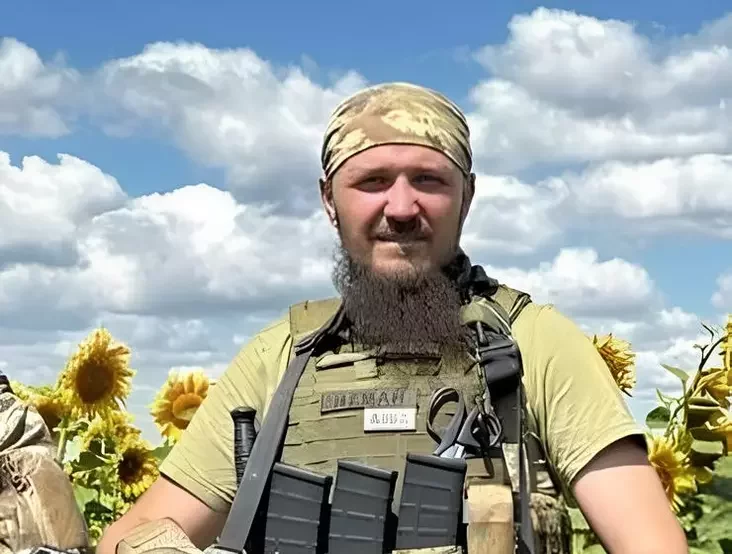
But in 2022, it escalated into a full-scale war; the question arose whether Ukraine would exist or not. This contributed to my arrival in Ukraine for the war."
"Nyoman" immediately joined what was then the Kalinoŭski battalion. And then he went to the "Volat" battalion — its 5th platoon was engaged in reconnaissance and infantry activities. Then, in 2022, "Nyoman" ended up on the Zaporizhzhia direction.
There he met Miroslav Lazouski — who was the commander of the 5th platoon. Lazouski, one of the founders of the "White Legion", left for Ukraine after the 2020 protests, and with the start of the war, joined the defenders of Ukraine.
"We heard something like 'let's hit them with something heavy' on the enemy radio"
"Nyoman" says that even before meeting Lazouski, he knew his name, knew about the "White Legion" case. On the front, "Mysh" (Lazouski's call sign) was "Nyoman"'s commander:
"He was one of those people who knew how to listen and speak. When he said something, it was more a request than an order. Relations with him were friendly, communication very sincere.
He was a very good strategist, excellent in military history — probably knew the Napoleonic era best. In the military sphere, he was very well-versed."
"Nyoman" recalls that combat mission in Bakhmut when Lazouski died — the interlocutor was also there. It all happened in May 2023.
The man says that for security reasons, he still cannot tell much:
"After our departure, the plans changed, and we were given a different task. It was a task to storm an enemy group. We came under fire, there was also contact with the enemy, and they started shelling us heavily.
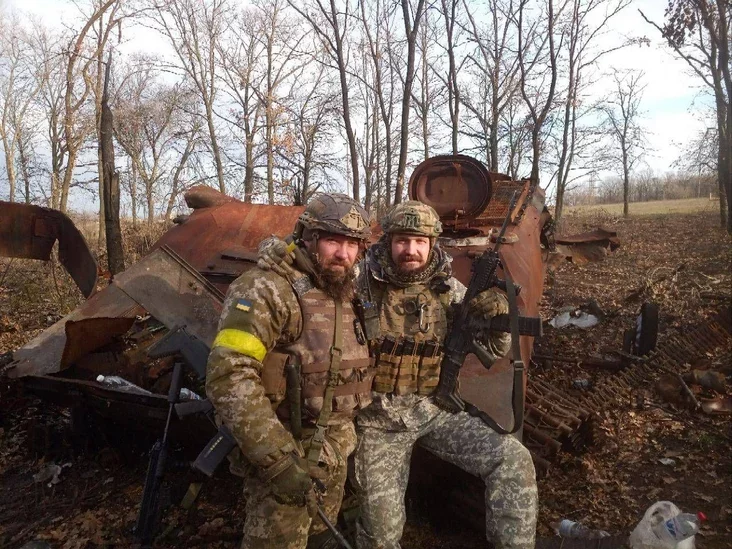
We had to retreat (fall back — NN) a short distance. Behind us was a multi-story building, and we retreated precisely there."
The night passed in fighting. In the morning, "Nyoman" recalls, the shelling began: the building where the soldiers were located was shelled by tanks and artillery.
"We had an enemy radio station, a trophy, and we heard something like 'let's hit them with something heavy' on it. Soon there was a powerful hit, and our building simply collapsed.
Four guys died there, half of our reconnaissance group. One guy walked out on his own two feet, and three others, including me, were wounded," says "Nyoman."
The interlocutor found himself under the rubble, unable to get out on his own. He was rescued by soldiers from an adjacent unit who came there with jacks and lifted the debris of the house.
"As I was crawling towards the exit, someone lifted me, I looked — and it was Miroslav Lazouski, "Mysh". He asked how I was, I replied — like, look at my leg. He looked and directed me for evacuation, handing me over to an adjacent unit.
They led me to a shelter, I stayed there for a long time. There were street fights all around, the shooting was already close. Later, at night, I was evacuated."
Lazouski, who was then engaged in the evacuation of soldiers, never returned from that mission. On May 16, 2023, he died.
"Nyoman" learned about Lazouski's death the next day — other soldiers who came to the hospital told him about it.
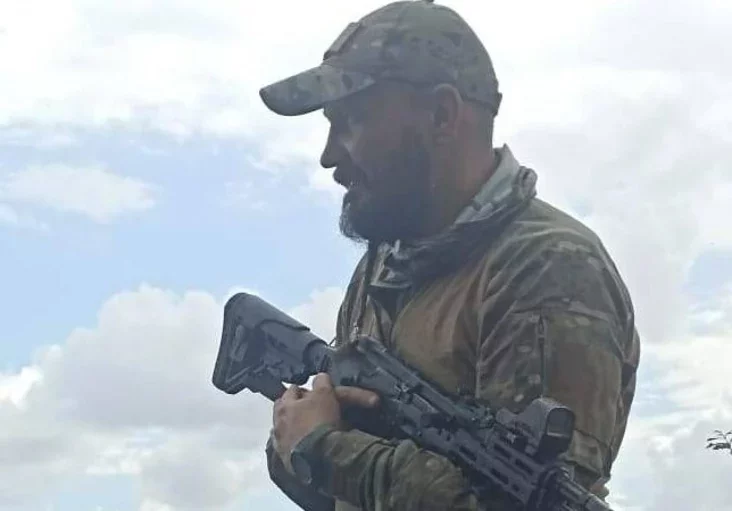
The leg, injured then, still reminds him of itself — sometimes "Nyoman" feels numbness in it. This was already the Belarusian's second injury in Bakhmut. At the beginning of the Bakhmut campaign, he suffered a broken shoulder:
"There was tank shelling, and I needed to run from one entrance to another. I took ammunition with me, and it was night, Bakhmut, everything was ruined. I don't remember how, but I just fell.
Then I got up, delivered the ammunition. Our medic ran up to me, gave me pain relief, put in a drip, and determined that I was going for evacuation. At the stabilization point, they told me that I most likely had a fracture, and then the X-ray confirmed it. The fracture was very complex, I was treated for about a month, and then several more months went into rehabilitation."
"First and foremost after the war — to benefit my country"
After Bakhmut, "Nyoman" fought in the Kharkiv, Donetsk, and Luhansk directions, and has several medals. Now, the Belarusian says, he spends a lot of time studying military affairs — saying, the war does not stand still:
"We see that the technologies of war are changing. Who would have thought before the full-scale war that drones would solve issues of reconnaissance, damaging equipment, adjusting fire. Such training for a soldier must be constant."
In peacetime, "Nyoman" wrote poems and even published his own poetry collection, but during the war, he writes nothing. When the war ends, he will be able to start putting his current experience on paper — "Nyoman" is confident that this will happen in his life over time.
But that is not the first priority:
"First and foremost after the war — to benefit my country. I don't know yet if it will be the defense sphere, education, public activity, or politics. But something will definitely be."
«Nasha Niva» — the bastion of Belarus
SUPPORT US


Comments