


Peter Thiel: The West won't be saved by beautiful words, but by hard work. The main principle should be 'does it work or does it not work'
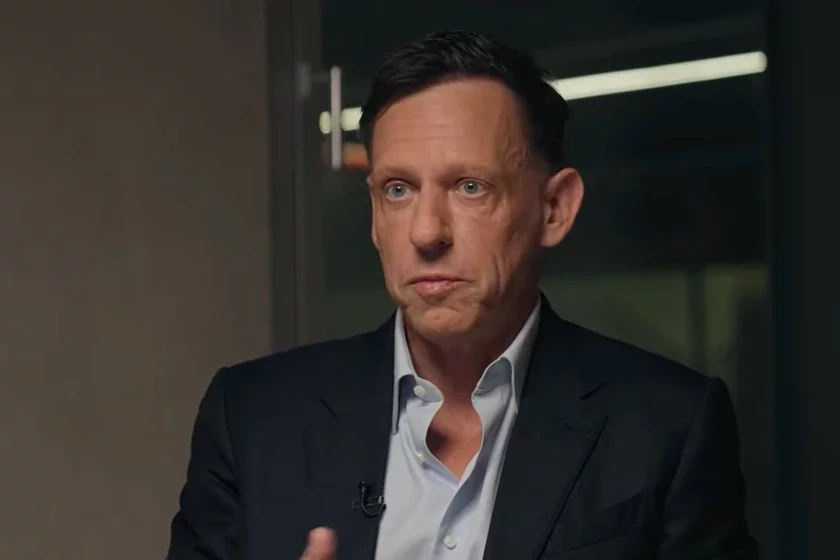
Peter Thiel is a visionary who became a billionaire. He is one of the founders of PayPal and Palantir and a venture capitalist. He gave a lengthy interview to Axel Springer CEO Mathias Döpfner, in which he reflected on Europe and the USA, China and superintelligence, right and left radicals, and whether humans can ultimately overcome aging and death. One of the intellectual gurus of libertarians, a sharp critic of left-liberals and socialists — Peter Thiel often looks further ahead than others.
Over the past twenty years, Thiel has consistently warned about dangerous technological stagnation for humanity. In his view, since approximately the 1970s, the West has sharply slowed down in its development.
Progress continued in the "world of bits" — computers, the internet, mobile technologies, and software. But in the "world of atoms," things were much worse. Mechanical engineering, chemical, aerospace, and nuclear engineering ceased to be the fields where the best engineering talent went.
By the late 1990s, the internet became an important engine of growth. But, according to Thiel, even it was not enough to bring the entire civilization to a new level.
Thiel sees in artificial intelligence a great chance for a new technological leap and an improvement in the quality of life for all. "And now I think that perhaps AI is something bigger than the internet and that it is, at least potentially, capable of accelerating growth again — with all the good and bad consequences of that."
Should AI be slowed down?
Thiel does not deny the risk that artificial intelligence, which will significantly surpass humans, could get out of control.
"Even if the probability is 5% or 10%, that's quite dangerous," argues the venture investor.
But from this, Thiel argues, it does not follow that we should move slower and always choose the most cautious path.
"If nothing is done, if there is no progress in any dimension, I don't think our societies will be able to function normally at all," Thiel believes.
Arguing his point of view, the billionaire notes that
Western society has for decades relied on an unwritten intergenerational contract: children should live better than their parents. This meant economic growth, greater material prosperity, better medicine, and new opportunities.
"And when that stops working, then, in my opinion, the whole society starts to behave in a very, very strange way. People often imagine the alternative to AI as a peaceful, sustainable society with zero growth. I don't believe the alternative looks exactly like that," Thiel argues.
In his view, the problem with liberal, free societies in the West is that they now lack confidence that economic growth will continue. People have stopped feeling that things are getting better. Politics is increasingly turning into a zero-sum game, a patched-up coat: to mend in one place, politicians cut in another.
"I don't think AI is a panacea for everything. But without it, I think these parties, which operate in the logic of a zero-sum game on the far right and far left flanks, will simply continue to gain strength," Thiel believes.
Threat to democracy in the West
As Thiel argues, a tendency towards weakening democracy truly exists, and liberal societies face serious difficulties. Political leaders are focused on how to come to power, while the question of how to fix deep structural problems in society and the economy is postponed.
Several decades of insufficient economic growth have weakened social ties. The intergenerational social contract has broken down. It is becoming increasingly difficult for the younger generation to buy or rent housing and to achieve the level of material well-being that previous generations enjoyed. Thiel calls Germany, Europe, and partly the USA "gerontocracies" — societies that now operate primarily for the benefit of the older generation.
Radical parties do not offer good solutions, but they are often the first to name the problem. And that is why they have the support of young people.
Thiel reminds that in the Berlin elections, the "Left" party (Die Linke) received 25% of the total votes, and among voters under 24, 47% voted for it.
The risk of a sharp turn to the left also exists in the USA. Thiel sees a real danger in "democratic socialists." In 1982, this movement numbered about 5,000 people. But during Bernie Sanders' election campaign in 2016, the organization transformed from a veteran community into a young revolutionary movement. The number of its activists grew to 50,000, and the median age dropped from 66 to 33 years.
Is it possible to slow down AI?
In Thiel's view, slowing down AI development would only be possible if there was genuine sincere cooperation among all states. But this would only be possible if there was a single world government that had real power and real enforcement mechanisms.
"The part of me that remains a classical liberal thinks that such remedies could be worse than the disease. Of course, there can be a fake global government where you discuss a lot, make many rather empty statements — and that's it. And, of course, there is a risk that as a result, AI development will be slowed down in the West, but not in China," Thiel warns.
In this context, Thiel sharply criticized the Pope's position on AI.
"The Chinese Communist Party will not listen to the Pope. But there is a possibility that people in the US will listen to him. So, in fact, the Pope's encyclical works for the Chinese Communist Party. I'm not saying he's a communist agent, but at least he acted as a useful idiot for the CCP," the billionaire criticizes.
At the same time, Thiel also disagrees with the desire to explain all of the West's problems by Chinese interference. He calls himself a harsh critic of China and considers rivalry with it extremely serious, but a significant part of the problems of Western societies, in his view, they create themselves.
Why is Europe less afraid of AI?
Döpfner drew attention to a strange paradox. America is traditionally associated with technological optimism, but it is there that protests against AI are already taking place. In Europe, the attitude is often calmer.
In Thiel's view, Americans fear AI because it is truly already changing their lives.
"Of course, the situation is still very dynamic. But at a first approximation, the picture is this: a lot is happening in the US, China is rapidly following, and Europe is extremely far behind. That's why in Europe it simply isn't felt. It's not even felt at the corporate level," the venture investor believes.
He also sees this with Palantir. The company's sales to American businesses are growing rapidly because corporations understand: they urgently need to figure out how to operate in the new era.
In Europe, this sense of urgency is much less: "There is still this inertia: we can wait. Don't do tomorrow what you can postpone until the day after tomorrow."
Competence instead of moralizing is needed
Modern public discourse is overloaded with senseless moralizing, says Thiel. Society constantly evaluates everything in categories of "good and evil," completely forgetting about the functional evaluation of "does it work or does it not work." In the real world, incompetent good intentions cause far more harm than harsh but effective work.
Technologies themselves are neutral, like an ordinary knife that can be used to prepare dinner or commit a crime. Punishing or banning the instrument itself is senseless; only the actions of specific individuals should be evaluated.
"We have all these discussions about good and evil, but at the same time, there's just so much badness around us. There's a lot that's not evil and not good, but just bad. If you live in a world where 99% of businesses, companies, people, political and business leaders are completely incompetent, that's the problem," the billionaire argues.
What can the welfare state learn from Argentina?
The venture investor draws attention to one of the main structural problems of welfare states, which include almost all European states — high taxes and large budget deficits.
With zero interest rates, such a model could be sustained for a long time. Now, debt servicing is becoming increasingly expensive.
Thiel sees three basic options: sharply cut government spending, significantly raise taxes, or continue to borrow money and postpone the solution.
After the 2008 financial crisis, the West, in his view, largely chose the third path. Thiel doubts that this can continue indefinitely.
What can happen as a result can be seen in the example of Argentina. In the 1900s-1920s, the phrase "rich as an Argentine" was common. However, since then, Argentina has plunged into a prolonged decline. Now Javier Milei is trying to reverse the situation through radical structural reforms to cut government spending.
"Can we somehow learn from Argentina's history so that we don't need a hundred years of decline before we get there?" the billionaire wonders.
Where should Europe be?
As Thiel argues, the European economy must grow, create new industries, and participate in building the future. If Europe can itself become a global leader in some field — all the better. If the lag is too great, it should cooperate more closely with America.
Thiel reminds that in the late 1960s, Europe was able to launch the joint British-French supersonic aircraft project "Concorde," catching up with and surpassing the USA. The supersonic aviation industry became a field in which Europe was a leader. But in the 1990s, the French project of a closed network Minitel ultimately lost to the global internet.
"If in 2026 you ask about AI: is this a story like Concorde or a story like Minitel? To answer honestly, my assessment is: Europe is even further behind than Minitel was at the time," Thiel argues.
The billionaire sees the reason not so much in the fear of failure, but in the "fear of success," which, in his opinion, is characteristic of European entrepreneurship.
If an American entrepreneur finds a working model, he might try to scale it to the size of Elon Musk or Mark Zuckerberg. A European, Thiel believes, will more often at some point sell the company or stop aggressively growing it.
The venture investor cites statistics. If you take the 50 wealthiest people in the US, only 12 of them belong to Generation X or are younger (born in 1965 or later). Of these 12, 9 earned their money themselves.
In Germany, among the 50 wealthiest people, 20 belong to Generation X. However, all of them inherited their wealth.
"No one has done anything new, created new wealth, built a large new business capable of scaling," Thiel observes.
As the venture investor argues, a new large company creates thousands of other wealthy people around it, tens of thousands of jobs, and entire new industries. Germany once knew how to do this. Thiel suggests that something in this mechanism broke down approximately after 1995.
Why doesn't Thiel want to die?
Thiel has invested heavily in biotechnology and longevity research for many years. And he openly admits that it's not just about business. His motivation is the fear of old age and death.
He reminds us that early modern thinkers expected science to alleviate the human condition, conquer diseases, and prolong life. Today, Thiel is "simply shocked by this societal decline, through which we have given up on all of this. People don't even think that we can cure Alzheimer's disease."
In the billionaire's view, there are various reasons why people have become more pessimistic. Medicine has repeatedly faced tasks that turned out to be much harder than expected. He recalls the "war on cancer" declared by Richard Nixon in 1971. More than half a century has passed, progress is enormous, but cancer has not been defeated.
Thiel is particularly interested in the possibility of understanding biology as an information system. If this succeeds, it would theoretically be possible not only to slow down but also to reverse some biological processes.
"Computers can live forever," says the venture investor.
However, he does not support the idea of "uploading consciousness into a computer simulation." Thiel believes human identity is deeply linked to the physical body.
When asked if eternal life wouldn't become unbearably boring, Thiel answers simply: "It's still better than the alternative. I don't think I would be bored."
Despite talks of eternity, the most concrete medical goal that the venture investor plans to pursue in the coming years is dementia. He would like to find a way to slow down or reverse the deterioration of the human brain.
-
Stas Karpau: Imagine for a moment that Prakopyeu was in Tsikhanouskaya's place. Or Karach
-
Krasulin: People in Belarusian prisons are not as at risk as Ukrainians targeted by missiles
-
Volha Harbunova: I don't want the opposition in exile to come to real power in Belarus, and Sviatlana to become president
Now reading


Nastassia Kostiugova on Statkevich's and Tsikhanouskaya's position: The proposal to «squeeze out» sounds like a proposal to wait for something unclear, and for an unclear duration


Comments