


Lithuanian researcher named the specific place where the remains of Vytautas the Great are hidden
Poland's interwar authorities hid the skeleton in the royal crypt of Vilnius Cathedral, claims Saulius Poderis.

Details of the historical investigation conducted by Lithuanian restorer Saulius Poderis were recently announced in the Neredaguota podcast and on the Alkas.lt portal. They systematized the researcher's materials previously presented during a thematic press conference in the Seimas.
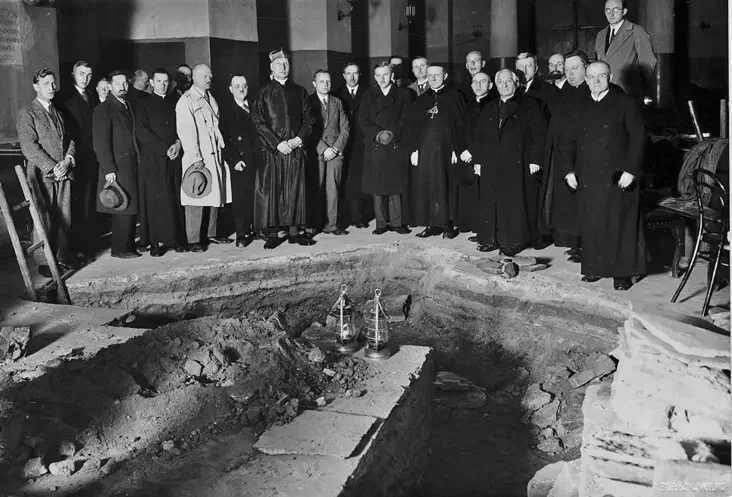
The story of the possible discovery of the Grand Duke's remains dates back to the catastrophic spring flood of 1931. At that time, during large-scale repair and rescue works led by Professor Julius Klos, a mausoleum with royal burials was found. Official historiography and the authorities of interwar Poland announced the discovery of only three bodies: Grand Duke Alexander Jagiellon, Elizabeth of Austria, and Barbara Radziwiłł.

However, archival materials found in Gdańsk archives cast doubt on the official version. Negatives taken during the construction of the royal mausoleum and anthropological analysis of the finds clearly show not three, but four neatly arranged skeletons.

This observation is indirectly confirmed by some historical documents. As early as 1806, Cathedral Prelate Franciszek Ksawery Bogusz wrote in his letters that Grand Duke Vytautas rests in the same crypt as Alexander Jagiellon. Researchers also draw attention to the original drawings of architect Klos himself, where the plans for the new mausoleum provided space specifically for four sarcophagi.
Where did the concealment theory come from?
Information that Vytautas's remains were found but hidden for political or conservation reasons did not appear out of nowhere. As follows from the documents collected by researchers, these rumors circulated in narrow circles of Vilnius intelligentsia for decades. Initially, sculptor Rafał Jachimowicz, who was involved in creating monuments to the Grand Duke in the interwar period, cautiously mentioned it. In the 1990s, this version was seriously studied by architect Romas Kazlauskas following archival traces.
But the most important evidence is contained in the memoirs of architect Vytautas Landsbergis-Žemkalnis, "From the Screen of Memory," published in 2009. The author relied on direct testimony from his colleague Jan Pieksa — the very architect who, in 1931, together with technician Vilkas, was the first to squeeze into the flooded royal crypt.
According to Pieksa's recollections, there were more burial sites and individual coffins in the underground than appeared in official reports. The commission deliberately concealed information, trying to minimize the scale of the discovery to avoid political disputes (Poles revered Jogaila, for Lithuanians the main hero is Vytautas) and not complicate the process of strengthening the emergency cathedral.
Where the remains of Grand Duke Vytautas could have been moved
An analysis of all these testimonies, as well as historical architectural plans of the cathedral, allowed Poderis to determine the most probable place where the fourth skeleton could have been moved in the early 1930s. This is an old, bricked-up entrance from the Vasa dynasty era, located in the foundation of St. Casimir's Chapel near the western wall of the mausoleum.
The dry corridor is about three meters long. It is located slightly above the level of the modern floor, precisely between the current arrangement of the coffins with the remains of Barbara Radziwiłł and Alexander Jagiellon.


If this is the case, the remains of the Grand Duke, inconvenient for the Polish authorities, were hidden so as not to trouble their conscience: they were left in the most honorable place, next to other princely burials, but behind a blind wall.
Poderis believes that to verify this version, neither millions in budget nor large-scale excavations are required. It is enough to obtain permission to drill a small hole in the historical masonry, through which an endoscopic camera with illumination can be inserted to inspect the cavities.
Why the Lithuanian state is not rushing to react to Poderis's hypothesis
The implementation of this simple technical plan is currently stalled, perhaps not least due to the specific reputation of the initiators.
The author of the hypothesis, restorer Saulius Poderis, was previously convicted for ties to black archaeology and is in open conflict with the archdiocese over disputes regarding the discovery of a cache of royal insignias. He is also known for signing a demand to ban Belarusians from using the historical coat of arms "Pahonia."
Among the first to already expressed his indignation at the inaction of the Lithuanian authorities in this matter was MP Vytautas Sinica, calling for Poderis's statements to be evaluated separately from the assessment of his person. Sinica was previously expelled from his own nationalist party for violating its charter; his person is primarily known to Belarusians for his actions demanding the expulsion of Sviatlana Tsikhanouskaya's office from Lithuania.
Currently, information about the exact location of the hypothetical burial has been submitted to the Ministry of Culture and the parliamentary commission on historical memory. The decision on whether an endoscopic examination of the masonry will be carried out remains with state institutions and the Vilnius Archdiocese.
«Nasha Niva» — the bastion of Belarus
SUPPORT USNow reading


The business of a member of Lukashenka's hockey team, who promised to build a ski arena behind the Supreme Court in exchange for prime plots, has collapsed

The business of a member of Lukashenka's hockey team, who promised to build a ski arena behind the Supreme Court in exchange for prime plots, has collapsed


Instead of metal roofing — oak shingles. A café opens in the center of Vitebsk, on the site of a former police station, in a flawlessly restored 200-year-old building


Comments