


"We plan to attract millions of euros in investments." Valery Astrynski reinvented agrobusiness in Poland
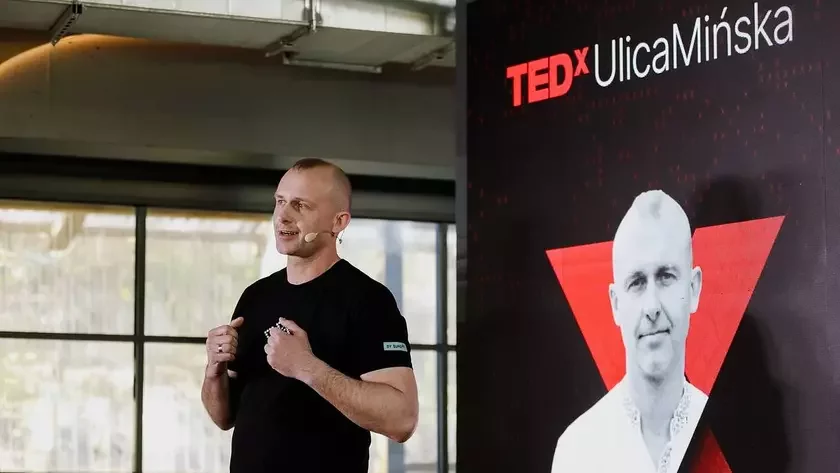
Entrepreneur and venture investor Valery Astrynski, after being released from "house arrest" on his farm in the village of Barova in spring 2024, moved to Gdansk. He wanted to create a Belarusian village near Toruń but ultimately came up with a business model for decentralized hotels, which he plans to scale across Europe. He is looking for partners who own land and wish to develop their own agrotourism business, writes devby.io.
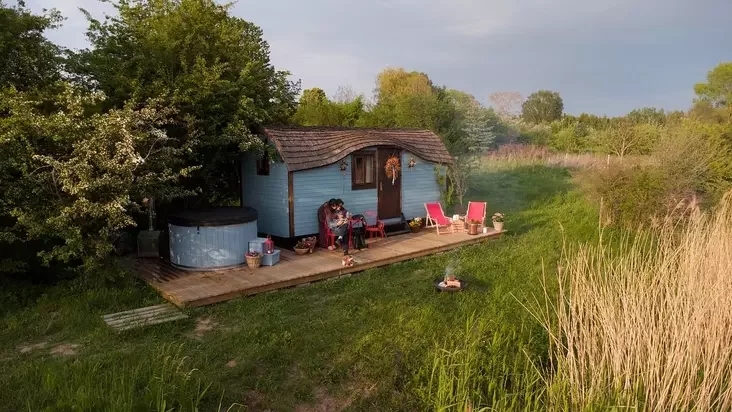
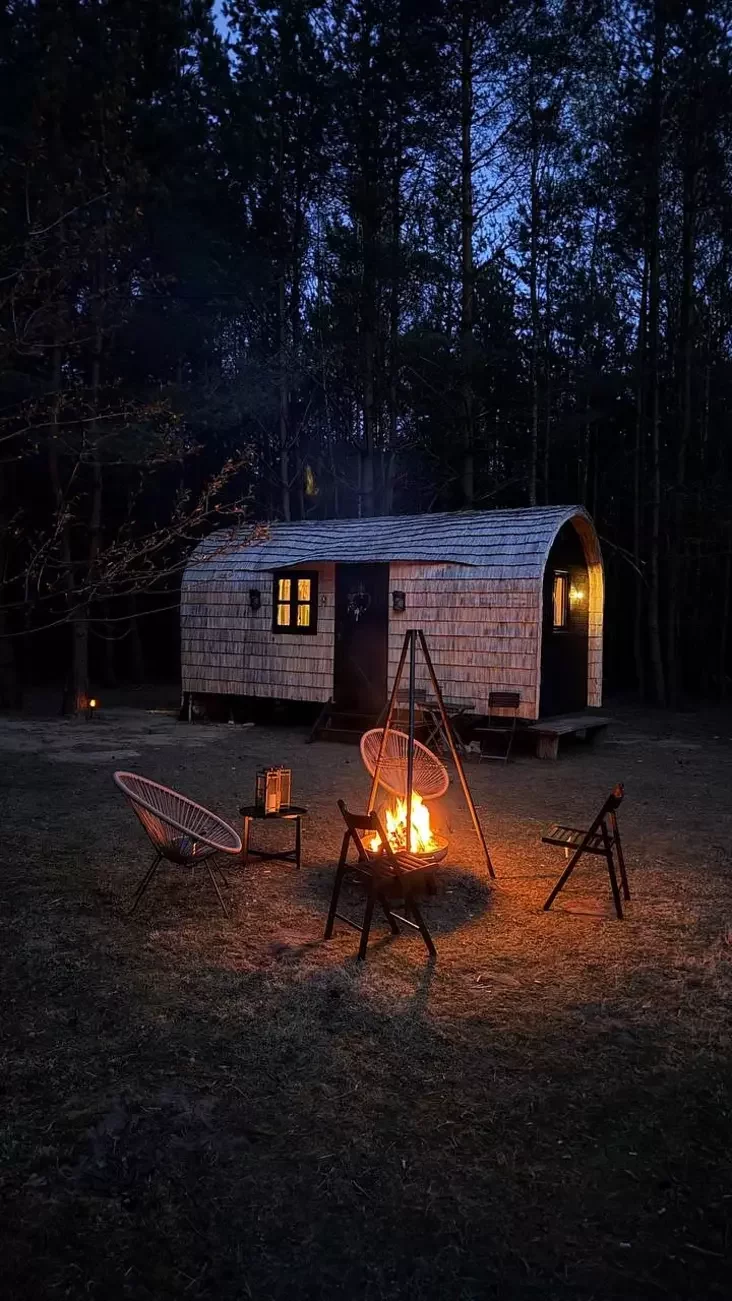
Currently, the entrepreneur has launched his own house production in Gdansk and three tourist locations, including an alpaca farm.
Why Poland?
According to Valery, it's not just about geographical proximity or cultural similarity. When choosing a country, he focused primarily on economic indicators.
— If we set aside subjective factors like community or similar culture, Poland is a promising country in terms of economic growth rates. Analysts predict that in ten years, Poland's economy could surpass that of England.
For the entrepreneur, this means a more favorable environment for business development. When the market grows, it's easier for new companies to find customers and generate revenue. The entrepreneur himself calls this "less internal market resistance."
Another argument was the comparatively lower labor costs compared to Western Europe. By establishing a company in Poland, there's an opportunity to utilize European infrastructure while maintaining lower costs than in Germany or the Netherlands. Nevertheless, Valery views Poland as an experimental testing ground for refining business processes before expanding to the global market.
— After all, my current status is not that of an investor, but rather an entrepreneur. I chose the hospitality niche — a sector related to my previous experience, nature, and recreation themes, as well as the potential for developing rural tourism in Europe. This market is growing by 10-12% annually. The product I conceived differs from what is already on the market. Therefore, my decision-making arguments were: the market is growing, it's large enough, I am in a country with cheaper resources — both human and raw materials. I have a long-term vision that this wave of trends will help mitigate even some of my mistakes, says Valery Astrynski.
Franchise hotel with 50/50 revenue split
— Tell us about Stativa's business model. Is this your only business in Poland?
— As an entrepreneur, I am currently fully engaged only in this project. It's the only business I'm involved in. Over the year, the business model transformed. Initially, I started with the idea of creating a company for producing small houses for agrotourism facilities, which could autonomously function in various locations in the future. Then I transformed this model into creating my own network of such facilities — metaphorically speaking, a decentralized hotel located in the most beautiful places.
At the same time, we do not incur capital expenditures related to land and utilities. We are looking for partners who already own land in beautiful locations. They live in that area and are ready to operationally participate in creating services for these houses. We essentially supply them with a house and handle marketing, attracting tourists to a specific location. And the partner on-site oversees the property, provides services for guests, and can offer additional services to them.
— So it's like hotel franchising?
— Yes, with time it could evolve into a full-fledged franchise. But today, we've settled on a model where we retain ownership of the house, which we transfer under a partnership model to selected plots. It's important for us to create a synergy effect: a beautiful place, engaged landowners interested in developing an agrotourism business, and our unique house that attracts guests.
After that, we split the revenue from guest accommodation with the partner.
— In what proportion, if it's not a secret?
— We have two models. If the partner already has experience in the hotel business, camping, or owns an existing agrotourism facility, we provide them with a house, they cover all marketing expenses, and then the income is split 50/50.
If it's simply the owner of a beautiful plot of land without experience, but willing to manage the property according to our standards and checklists, then we take on all marketing, generate a flow of tourists, and ensure occupancy. In such a case, the partner receives 30% of the total revenue.
— Does this mean that practically anyone with land can join and work with you?
— Yes, but, firstly, it must be a truly interesting and unique location. We want to create an atmosphere of solitude for city dwellers. The houses should not be too close to each other. It should be some clearing or a beautiful scenic spot where one house stands, and the next is located at a sufficient distance and is almost invisible.
But it's not just the place that matters, but also the person living on that land, willing to clean the house, receive guests, and manage the operational part. This is a partner business.
— Does the land have to be owned or can it be leased?
— That's the partner's question. We ourselves are not currently leasing land plots to avoid entering into all legal relationships with the local administration. As a rule, a person who already lives in a specific area better understands how to interact with the administration and what regulations apply there. Especially since requirements differ in various places, even though our houses are mobile.
The minimum contract term with a partner is five years. We expect the cooperation to be long-term and productive. Ideally, the agreement could become indefinite. Therefore, we are not particularly concerned whether the land is owned or leased. The main thing is that the partner has the right to conduct an agrotourism business on it.
— Are your houses listed on Booking and other major platforms? How is the marketing model structured in general?
— For now, yes. At the first stage, we are present on Booking, Airbnb, Slowhop, and other platforms. In parallel, we are developing our own platform. Perhaps with time, if our marketing becomes strong enough, we will be able to ensure the necessary occupancy exclusively through our own channels. But it's too early to talk about that yet. Therefore, we cooperate with all major platforms and pay them commission.
Who can earn and how much from this business
— What interesting properties do you already have at your disposal?
— We started with properties near our house production facility, which is located in Gdansk. So we found our first partners nearby — on a beautiful plot on the riverbank in Żuławy. Currently, two houses stand there, and in the future, there will be four. This is exactly an example of the partner we would like to see. These are city dwellers who moved out of town and are involved in various creative projects: they conduct handicraft masterclasses, bake bread, make jam.
They actually already have their own customer flow and good social media. And we add our houses to their project and bring more professional management to it.
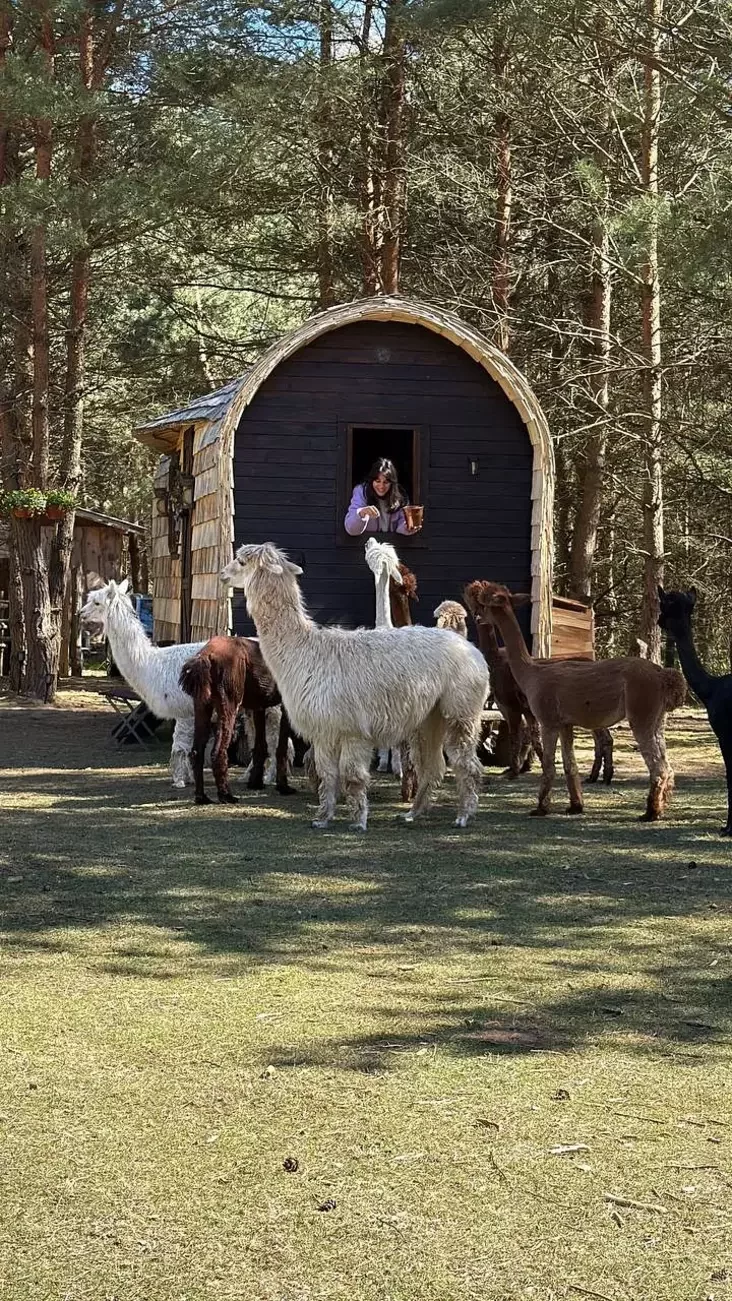
The second property is an alpaca farm. Also a story about city dwellers who moved out of town, bought land, and started breeding alpacas. Here we are testing a model where the house is located directly next to the animals. Alpacas freely roam around, approaching the house during their walks. For guests, this creates a unique experience of close contact with animals.
A third house has already been delivered to a new location near Krakow — it will start welcoming guests in a week. Two more houses near Wrocław and Warsaw will be operational by the end of June. At this stage, my plan is to install 20 houses by the end of the year and test the business model in Poland with these properties. Because there are several development options. I've already talked about two partnership models, but there are other variations. So we are launching different formats on different properties, collecting statistics, and then we will decide which model is most effective.
Further growth — to hundreds and thousands of houses — will then be built around the most successful partnership format.
— Let's say a person comes to you and says: "I want to work with you." What income can they expect?
— If we take the average statistics for Poland, occupancy is about 55% per year. The average rental cost of our house is approximately 550 zlotys per night. Given these indicators, the annual revenue is quite good. Of course, not in the first year, because any location needs time to become known and build a reputation through word of mouth. But starting from approximately the second year, a partner, if we fully take on the marketing, can expect to receive about 30-35 thousand zlotys of income from one house per year. Therefore, we strive to choose locations where there is potential to accommodate four to five houses. Then a family living in that area can already receive significant income from such activities.
Although, as a rule, partners are involved in something else in parallel. And all additional services — cooking, saunas, masterclasses, excursions, and other activities — remain an additional source of income for the partner. Here, much depends on their initiative, creativity, and desire to develop the project. In essence, we provide the house and bring in tourists, and then the partner can create additional products and services, increasing their earnings.
— What determines whether one or five houses will stand on a plot? Is it the size of the land and the partner's desire, or are there any regulatory restrictions?
— Rather, it depends on the size of the plot and the specifics of the location itself. There are no strict restrictions here. We fundamentally do not want to place houses close to each other, because our client is a person tired of the urban environment and civilization. They come for a sense of solitude and peace.
Therefore, guests of different houses should not disturb each other. First of all, we look at the area of the plot and the availability of several beautiful vantage points where houses can be placed while maintaining privacy.
Millions of euros in investments
— By the way, how is your plan to build a Belarusian village near Toruń progressing?
— Such an idea did exist. But at some point, I didn't see enough economic justification in it that would allow attracting investors for this project. It's more like a social project. One family living there and managing the property could earn from it, but for me, that's not enough from a scaling perspective. So for now, I've put this idea aside. I hope an active person or family will take on this idea.
— Perhaps there would be more willing people to implement this initiative in Podlasie?
— Perhaps there would indeed be more willing people. But Podlasie is a specific region. Especially after the closure of the Belarusian border, when the tourist flow significantly decreased. I am now looking more towards the Netherlands and Austria as the next markets after Poland.
— So you plan to scale to other countries?
— Yes, definitely. That's the main idea of the project. It was initially conceived as a business with high scaling potential. Currently, Poland is our training ground and a place to fine-tune processes. In Poland, we are studying mental consumption patterns: how people relax and spend money. This understanding can then be transferred to other European markets.
Our goal is to install about 20 houses in Poland by the end of the year (10 houses will be operational this summer). To refine all business processes and then enter markets where the average rental check is higher. In my opinion, that's where the main growth potential lies.
I initially did not consider the option where the company would be limited to the Polish market. Most likely, when it comes to attracting larger investments, the parent company might be structured in a different jurisdiction.
— Are you currently looking for investors?
— Yes. We are currently attracting investments. In Poland, we have already opened a PSA — a joint-stock company. The first "angel investors" have already joined the project and financed our current growth phase — the development of the network to ten houses.
Further business logic dictates that we do not sell houses, but build them for our own portfolio, thereby increasing the company's capitalization.
— How much do you plan to attract in the next stage?
— Our next round will be for approximately one million euros. Most likely, we will open it in the autumn. Subsequent rounds, I hope, will be for even larger amounts. Everything will depend on how quickly we can establish production capacities. In fact, investments will be attracted to increase production volumes, and that is also a process that needs to be developed gradually.
— Can we reveal a little bit of the secret: who are these investors?
— These are Belarusians, but many already have passports from Poland, Israel, the USA. The first angel investor is someone who has known me for a long time and trusted me at the early stage of the project. I'm not ready to disclose names yet, as I haven't received consent for that. I think that by the next round, the information will become public. After all, it's a joint-stock company, and the register of main shareholders will be open.
— What does the economics of one house look like? How long will it take for the investments to pay off?
— According to our calculations, one house should bring the company about 100 thousand zlotys in revenue per year. Taking into account operating expenses and the partner's share, investments in a house should pay off for the company in approximately two years. Such internal economics are embedded in the model.
Of course, there are also factors related to marketing development and brand recognition. But investors who studied our financial model and internal documentation agreed that the project looks promising both from a growth and profitability perspective. Especially since the model itself is not unique. There are similar projects in Australia, Germany, and England that have already attracted tens of millions in investments. This niche is called Instagram cabins. It's difficult for me to call them direct competitors, but these are more mature companies with a similar business model that I look to.
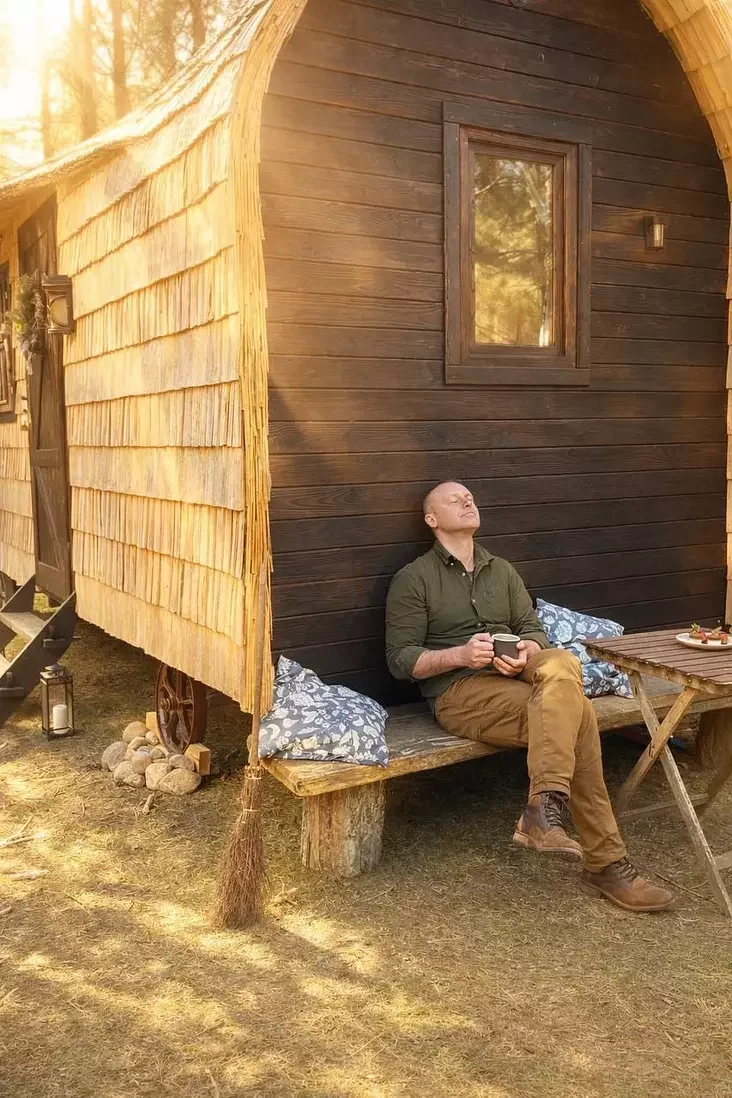
Most of them make houses in a Scandinavian style: plywood, solar panels, large windows. I decided to add more authenticity and natural harmony to this niche. There have already been successful deals in this area. For example, two years ago, Marriott acquired Postcard Cabins, a company that managed approximately 1200 such cabins.
Therefore, there is an understanding that this niche is interesting to large funds and strategic investors if the company demonstrates a working financial model. In the long term, such a business could be sold to a major player.
Own production and houses for 10 thousand euros
— What is considered successful occupancy for a house?
— Currently, we are targeting the average for Poland — about 55% occupancy throughout the year with an average check per night in the range of 500-550 zlotys. It is understood that a property needs time to go through seasons and off-seasons, gain recognition, and start the word-of-mouth effect. Therefore, as a baseline, we use exactly this figure — 55%.
At the same time, if you look at the analytics of more mature companies, you can see individual locations with 70-80% occupancy. But then many factors must align.
We conducted research that confirms that domestic tourism and agrotourism are very popular in Poland. This was unexpected for me, because in Belarus, such a culture of recreation is much less developed. Many agrotourism facilities set a minimum rental period not for one or two days, but immediately for a week.
— Are there any support programs for agrotourism in Poland, similar to those in Belarus? Have you used any of them?
— So far, frankly, I haven't. I know there are support programs for depressed regions, including Podlasie. Funding can be obtained for landowners who develop similar projects.
There are also programs related to ecology, green energy, and sustainable development. But I have left all these questions for later. We still need to grow a bit to that level.
— Can you tell us about the mistakes made during the project launch?
— We have a fairly classic startup story. At first, I started making a house just for myself. Then the idea emerged to produce such houses for sale. We did sell several properties and gained good experience. But it turned out that the costs of producing atypical houses are much higher than I had estimated. Perhaps now I wouldn't embark on similar experiments. On the other hand, it was important experience.
Today, I definitely don't want to engage in custom house production and am trying to move away from any non-standard solutions. We have already defined two main models, optimal design options, and color schemes. Now we want to move as much as possible towards standardization.
— How much does it cost to produce one house?
— The question is not simple, but if we're only talking about materials, then approximately 10 thousand euros go into one house. Labor costs can range from 10 to 30 thousand euros, depending on the efficiency of production.
So far, our processes are far from ideal. We are essentially doing reverse engineering: first, we come up with a solution, test it in practice, and only then formalize the design documentation. This allows us to optimize subsequent iterations in the future.
— That's a very attractive price. Does that mean I can come to you and say: "Make me such a typical house for my dacha for 15-20 thousand dollars"?
— That's exactly the business model I don't want to pursue. I'd be happy to tell and show you how we do it, but if materials cost around 10,000 euros and labor is roughly the same, then the economics of an individual order look completely different.
In addition, our product cannot be called typical. Simpler and cheaper houses can be found on the market. Round shapes, wooden shingles, and other elements significantly increase the cost of the construction. But it is precisely this visual "wow" effect, in my opinion, that is particularly important for short-term rentals. For a person buying a house for their own use, such features are not always decisive.
— Do you have your own house production or do partners also handle this?
— No, we have our own production in Gdansk. A team of nine people in production and five more in administration and marketing. All Belarusians. Many, unfortunately, cannot yet return to Belarus for political reasons. This means we already have a full-fledged small production with a social SDG function.
Where to invest 100 thousand euros
— If we imagine a person who has moved to Poland and has, for example, 100 thousand euros, how would you advise them to dispose of this money to likely make a profit?
— If the person is not a professional investor, then perhaps the simplest option is to invest in the S&P 500 index through the US stock market. Because if a person doesn't have specialized expertise, money is quite easy to lose. Beyond that, much depends on how well they understand the field they are investing in.
It's one thing to invest money in your own business. It's another to invest capital as an investor.
— And speaking of business, which areas in Poland seem most interesting to you for development?
— With real estate, things are not so clear-cut right now. Although outwardly, it may seem that the market continues to grow. If the alternative is to pay rent or direct a comparable amount towards buying your own apartment, then perhaps there is sense in that. But when it comes to broader investments, I am probably not the most competent person for such recommendations. I still better understand investments in projects by specific founders whom I know personally. Or in businesses operating in a growing market.
Now, for example, there's enormous interest in AI, but no one can accurately predict what this market will be like even in two years. Therefore, when talking about a sum of 100 thousand euros, the wisest option is diversification. It's better to allocate funds among assets with different levels of risk than to bet on one thing.
— In your opinion, what projects are missing in Poland?
— It seems to me that there is room for service solutions that make people's lives more convenient. This primarily concerns IT products: personal assistants, automation services, tools that improve quality of life and save time.
But it must be understood that all this falls into the category of venture investments, which means it is associated with a high level of risk. Therefore, when it comes to a single sum of 100 thousand euros, it is still better to distribute it among different areas.
— And then the last question. What has fundamentally changed in your views on business, investments, and entrepreneurship in general after emigration?
— Perhaps the strongest change is related to the feeling of disappearing borders. This greatly influenced my thinking. When I lived in Belarus, it seemed to me that to create a large company, you absolutely had to focus on exports, open branches abroad, overcome many barriers, and gradually build an international structure. But at the same time, keeping the business center in Belarus, you were still constantly within certain limitations.
Now, being in Poland, I no longer feel any limitations to starting a business in Germany, the Netherlands, or Austria. I perceive it as a single large European market. Therefore, my understanding of business opportunities and scaling has greatly expanded.
-
Exotic fruits from Colombia were brought to Minsk stores
-
"Thank you, Lena! Continue observing." The officer who wrote to Kharysava, lurked in political emigration chats, and even offered some girls to exchange nudes
-
How the ancient church, for the salvation of which the state is collecting donations, looks now PHOTOS
"Thank you, Lena! Continue observing." The officer who wrote to Kharysava, lurked in political emigration chats, and even offered some girls to exchange nudes


Comments